The Ghostbusters II effects hold up even better, but that’s because ILM was fully operational when they started work on the film.
At least for now I haven’t seen a film in 3D that hasn’t given me headaches and made me feel nauseous. Maybe they’ll turn down the brightness and saturation of the ghosts for the 2D copy.
If you see it in 3D I hope you really enjoy it!
Recently I saw the film “The Walk” and it was probably my favorite film of 2016 so far. They did a really great job, and it is a beautiful tribute. I felt 1,368 feet up even though I saw it in 2D (on a 48 inch TV) and not 3D IMAX like everyone said to.
Uhm, well, not being Feig or involved with the production in anyway, I can only conclude that they went with their own way with the ghosts to create their own iconic look, to have something that can’t just be considered a pale imitation or a “copy” of how the 80s films did them.
There’s also been the technical explanation that they may’ve been done this way to work better with current 3D cinema technology.
It’s sorta like how Nolan’s Batman franchise didn’t use the same design of suit that Keaton’s did, or how the suits worn by the First Order Storm Troopers are inspired by the classic Storm Troopers, but different enough, they’re a way for a director or art director to put a bit of their own stamp and influence on things.
I don’t think that’s automatically a bad thing. Having never seen a ghost, neither strikes me as being more or less an accurate a depiction of a paranormal entity.
One complaint that seems to come up a lot with Ghostbusters II is the Statue of Liberty and how she doesn’t actually have feet, yet becomes able to walk.
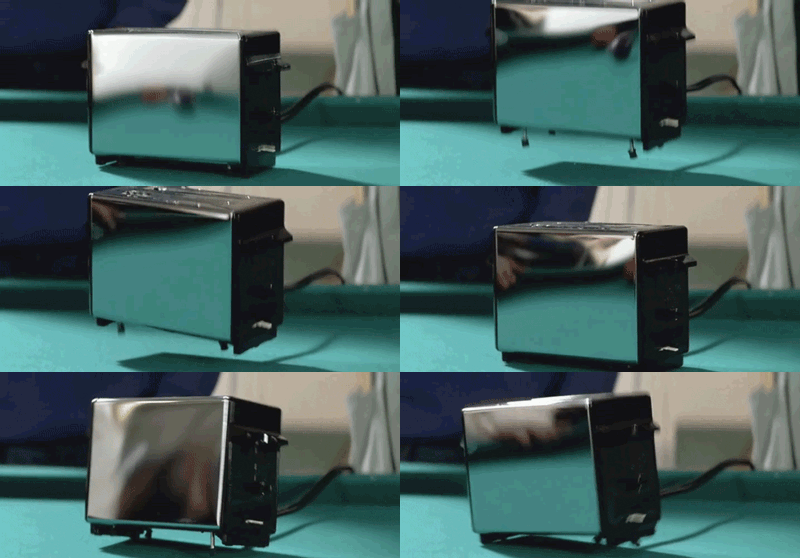
It seemed like an odd complaint since the slime obviously manipulates objects, like the toaster which grows feet so it can dance:
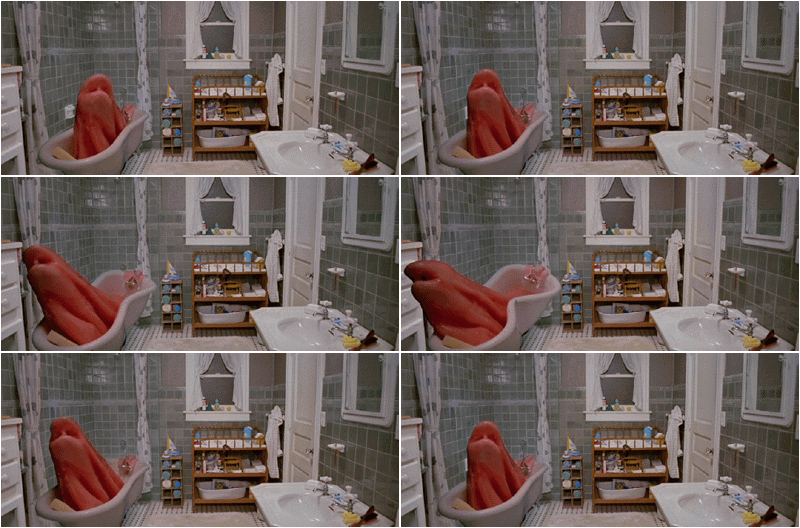
The tub, which wouldn’t bend like that without the influence of slime:
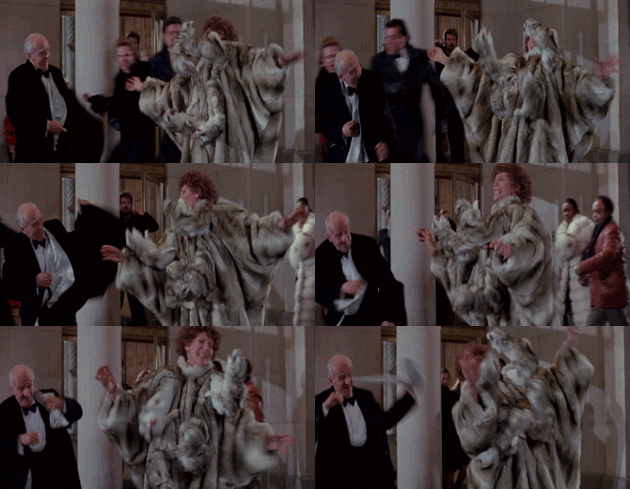
The mink coat:
So wouldn’t it make sense for the Ms. Liberty to gain the ability to walk?
The Staypuft scene, although iconic was borderline childish. The liberty statue was just childish and really relegated GB2 to kids movie territory towards the end in my opinion.
The statue is a wireframe metal structure with overlying panels. It has no skeleton or joints or even feet. To have it just hover over the streets would have been more “realistic” eerie Twilight Zone rather than the Scooby Doo kids effect we saw in GB2.
Yes I realise I’m talking about the “realism” of a possessed 150ft statues’ dynamics of possession, but as we all know these things affect the “tone” of a movie. Hellraiser is equally improbable but scares the ■■■■ out of you.
As for the grading. I’m a commercial advertising photographer who lives in Photoshop. We all have a moment where everything you continue to adjust starts to be over the top. It starts to look less and less real. The '14 BR toned the “color corrections” applied between 99-09 down, so that the movie looked more like the original release.
Sure, some things needed tweaking, the blown out whites in the rooftop scene, etc. But on the whole all the post 99 releases look faker to me in terms of color.
Its hard to explain but the tonal gamut and contrast ratio of the effects/ghosts/beams appears mismatched to the film grain of the scene itself.
Like in the cleaning lady blasting scene, at the ISO level (film sensitivity) and contrast ratio (lighting) used in that scene, the sudden appearance of the beams would just look like a blindingly bright predominantly whitish / orangish color.
The later releases add very detailed bit depth, hues and tonal range to effects like that, and some ghosts for example, where its mismatched to the film stock. Sure the remastered effects are rendered in 32-bit software with huge gamuts… But the original film stock would never have displayed that detail!
At the grain level, focus and lighting visible in a scene, the VFX could not possibly be there in real life the way it looks on the film. It’s evidently painted on, and takes you (even if a little) out of the immersion. (Subconsciously for a non-professional image-maker I suppose.)
Like getting a 0.2 megapixel Sony Ericsson phone from 2002, taking a 640x480 pixellated video with it. Blow it out to 4K resolution (it will still look as bad, as you cannot create new information by simply enlarging a source), and then go and add 4K hyper detailed effects to it. It will obviously look fake.
I put it down to messing with something too much where you begin to lose sight of the forest through the trees. It’s why the 99 DVD release looks most “realistic” or “vfx matching environment” to me. I think those original cinematographers and vfx guys knew what they were doing.
An important part of a Visual Effects Shot (or any shot really) is the Cinematography, as it can make or break how realistic or convincing an effect is perceived.
It also delves into a bit of visual symbolism I’ve come across in both films.
I didn’t look into the Cinematography of the reboot only because it would’ve made the essay longer, but once the film comes out I probably will make a write up about it too.
Just chiming in to say that I now feel a bit silly about looking at the color properties of the effects in the reboot, since I’ve noticed that they change considerably between every trailer, TV spot, vignette, etc. It’s possible that the Luma write-up is credible, but I haven’t gone back and checked it.
Even though the information about the reboot can be discarded (Ghostbusters and Ghostbusters II are still good,) hopefully it can still be used by someone to help them learn to read a Vectorscope/YC Waveform.
It may be too soon to ask this, but since it is in 13 days, I was wondering if anyone would be interested in seeing a cinematography write up on the reboot effects? :love:
Sav, I’ve actually been taking a lot of screen grabs of the “before” and “after” shots that we’ve seen from all the different trailers, TV spots and vignettes, fancy combining that intended topic I was gonna post with your own write up?
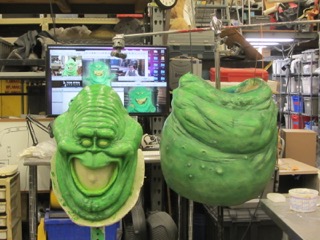
They used a technique that I had never seen before, by using a physical prop on set, and then applying CGI on top of it. This varies from the first film, where Slimer was in a fixed position, shot against black (therefore not exposing that part of the film,) with the camera moving around him, so that once composited it looked like he was moving around. In the second film he was still shot on black, but the camera was static, and Slimer moved around on a stage.
Which brings me to a point I wanted to talk about. As someone who is slightly biased towards the look of Practical Effects, I have to say that the argument of having a physical object to interact with on set as opposed to a tennis ball has been misinterpreted and is currently somewhat silly. In the original two films, they had nothing to interact with, not even a tennis ball. The ghosts were optically composited into the shots after the fact, as with any shot from any movie that is a composite. That argument is only good when it comes to replacing in camera effects with CGI, not Optical Composites.
Now that is not a dis to the reboot. I have a huge amount of respect for them listening to people’s complaints about CGI, and taking the public’s advice on how to make effects better (even if some of the public is misguided.) It probably made the actor’s performances better. I’m just saying that the argument is not meant to support Optical Composites (even though it has been spun that way,) it’s meant to support in camera effects. As far as performances go, this new technique probably gets better performances than those by actors performing with Optical Composites, although it would vary by the actor.
Very cool “Slimer” article. But holy ■■■■ Sony! Reading the bottom of the page:
“Pleased with our work, we were anxious to see the finished product. Going in, we knew that we would be serving mainly as movement reference, and sure enough, the animators faithfully duplicated a lot of the movements we created on set. Unfortunately, worse news was yet to come: at the end of the film, the great work by TCS and crew was completely left out of the end credits. For a $144 million film, it’s disappointing to deliver something of value above and beyond what the Director and Production have requested, to have great looking Practical FX smeared over by inferior CG work, and to then be not given the credit deserved.”
That shocked me when I read it. How can Sony be so unprofessional?
In my opinion Slimer looked better in the originals than he has in the reboot trailers (my theater didn’t get the film so that’s all I’ve seen so far,) and the puppet they built looks on par with the original Slimer puppets, so it’s a shame that they smeared it over with inferior CG (no better way to put it.)
I see you only have a few posts, welcome to the site!
Here’s a hypothetical, would a major film studio allow a movie to be made nowadays using the same SFX/VFX techniques as Ghostbusters (and GBII) if it had roughly the same amount of special effects as they did? Or would it be too much of a risk?