It’s true, we have no idea what we’re doing. Me and 2 other friends are going to re-create the Nasa Apollo Guidance Computer. We are armed with simple PDF’s from the interwebs (here) and no knowlede of PCB’s, ICU’s, sockets, resistors, or construction, we are going to prove any idiots can build something amazing from history.
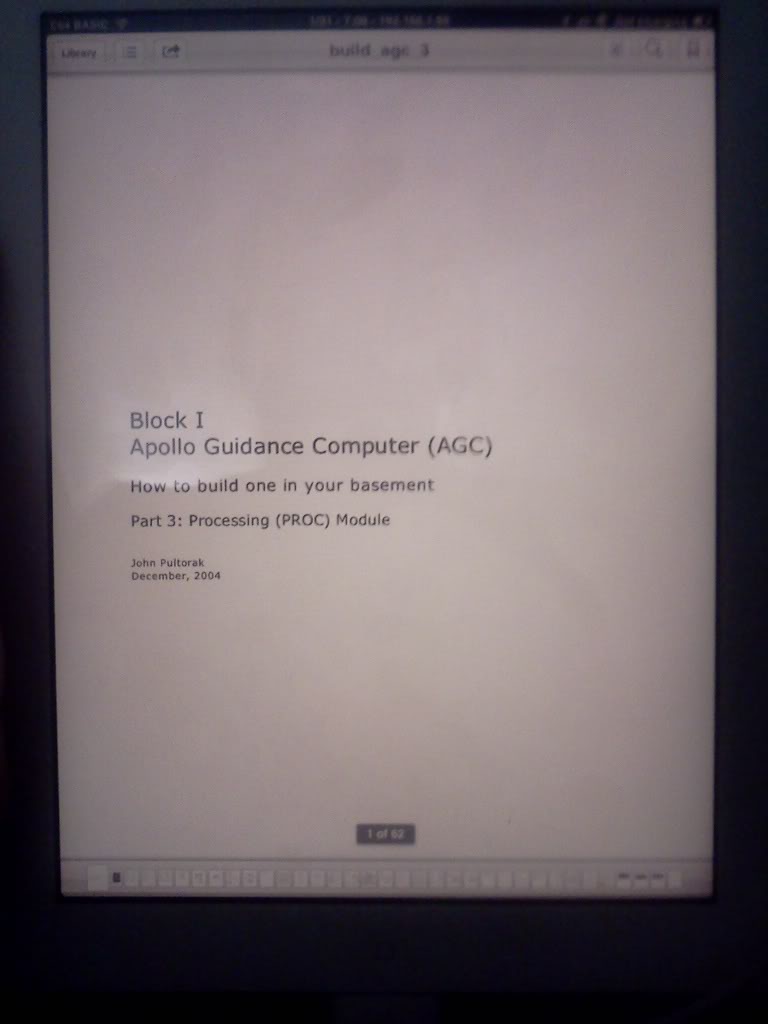
An iPad filled with all the docs, websites, and info we could possibly need. It even has an app for figuring out all the electrical resistance and will be our reference tool for EVERYTHING. We start at dawn… this will be fun.
All the while no doubt basking in the irony that the iPad is millions of times more advanced in terms of computing power. It still boggles my mind to think that my cel phone could outpower the computer that took people to the ■■■■■■■ moon.
I’ve been on a bit of a space exploration nostalgia rush the last several months, with a couple of Airfix Saturn models to show for it. I look forward to seeing your project as it develops.
Well, to put it in perspective, the power requirements for your cell phone are a lot higher than those of the Apollo guidance computer. Everything in the Apollo mission was designed to basically run off battery power for a week, and batteries were pretty ■■■■ back then compared to Li-ion, etc stuff we have today.
Interesting project, basicly like building any early computer (altair, eniac, apple) it’s pretty much the minimal backbone of how most PC’s work today just way smaller in functionality. The funny thing is the actual computation it does isn’t really all that hard, it just wasn’t possible for the crew to do it fast enough manually.
Amazing isn’t it? Well so far our goal is to simply learn, learn everything about schematics, what all the numbers for part lists mean, what to do with PCB’s, all that good stuff. Anyone got some beginners tips for us? haha.
Compartmentalize as much as possible. The computer can be broken down into sections, figure out what can fit on a standard breadboard then work out from there what you’ll need for the whole project. It’ll give you an idea of what your basic structure costs will be. It takes me 2 breadboards just to do pack lights and that only uses 4 chips and 18 transistors.
Got ya, I imagine this project will be huge (the pictures of the guys first model fit snuggly in his basement!), so I will definitely try and split this bad boy up. Should be a lot of fun to do.

 haha.