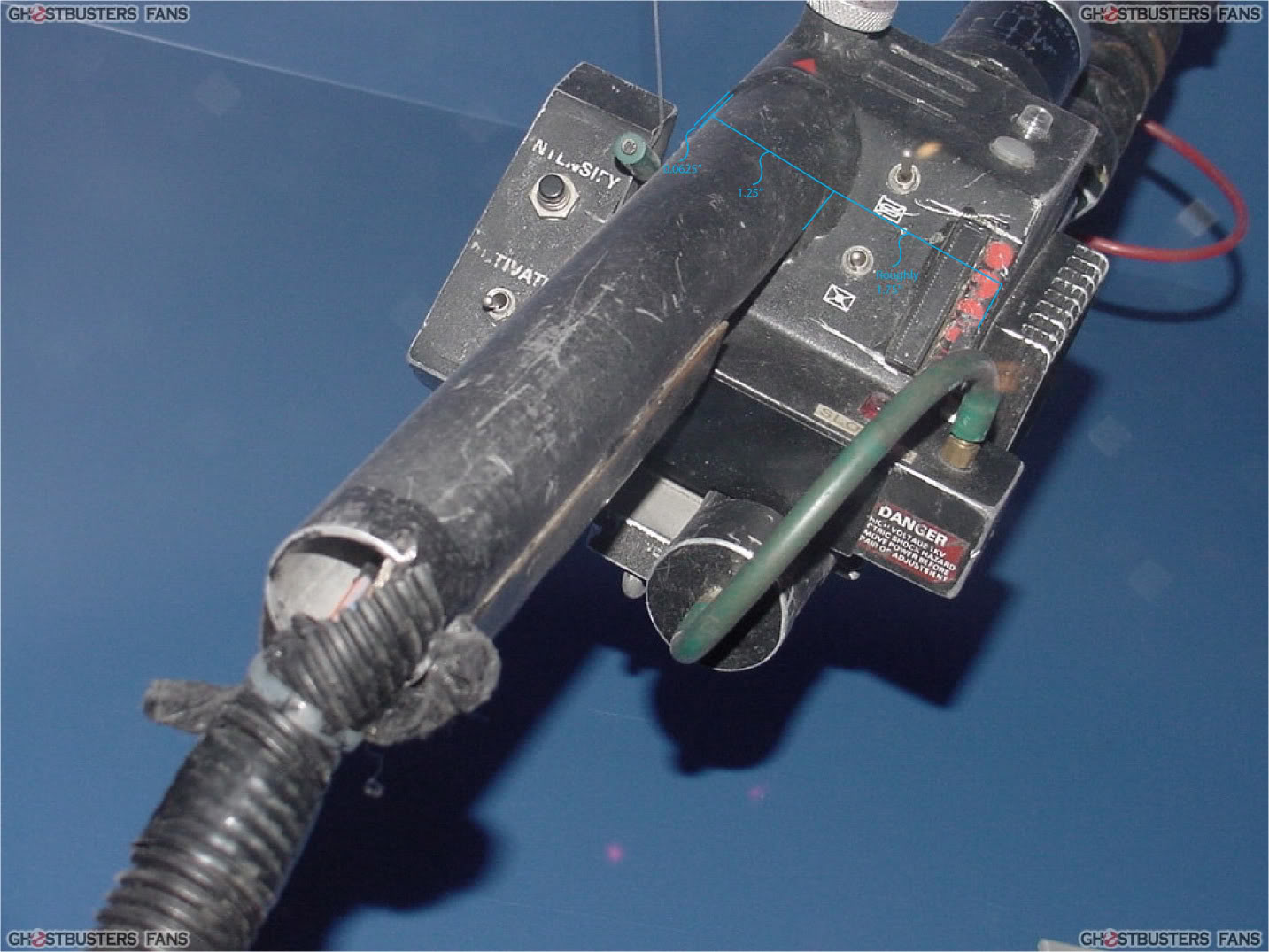
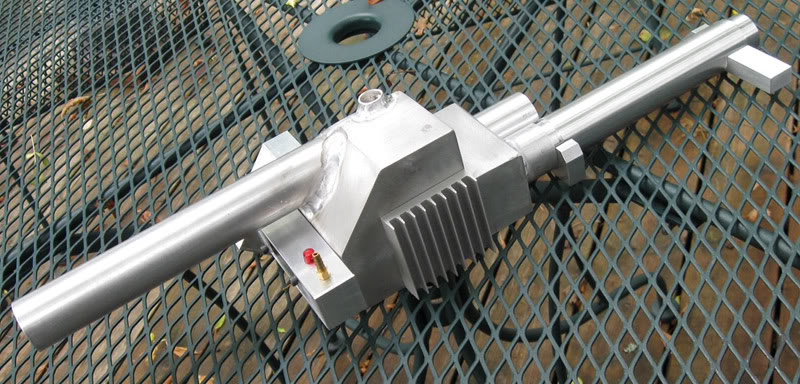
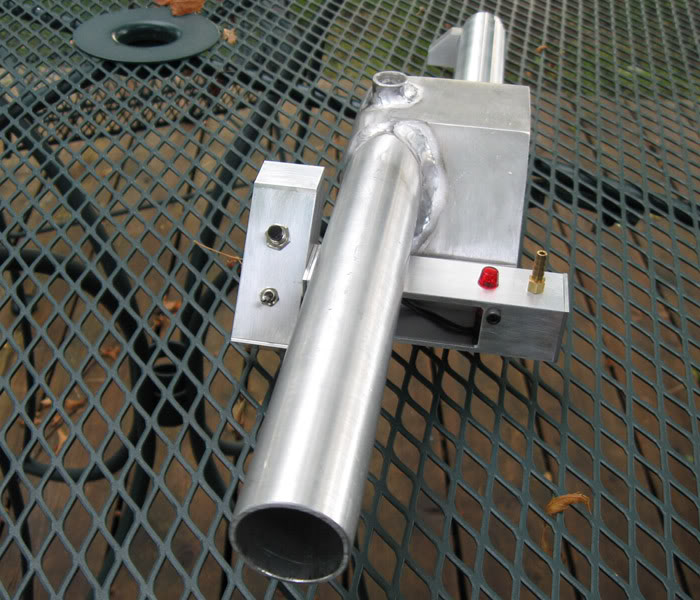
I have heard everything from 1" to 1-1/2" to 1-1/4"… Which is it!!!
PVC is measured by inside diameter so sizes can be confusing to those who are new to it. The proper tubing to use is called 1"(yes, one inch) thin-walled PVC
it has an outer diameter of roughly 1-1/4" which is very close to the screen accurate aluminum tubing used.
THank you!
JC
Not so fast!
Kind2311 is mistaken.
The correct outer diameter of the handles is closer to 1" than to 1 1/4".
1" PVC has an outer diameter of 1 5/16" and an inner diameter of 1".
1" thin-walled PVC, has an outer diameter of 1 5/16", and an inner diameter of 1 3/16". (Yes, I know, that doesn’t make sense.)
Before I built my pack, I would have told you the same thing he did, but I was wrong. So very wrong.
I was convinced by someone I trusted that the 1 1/16" OD electrical conduit I bought from MMM was the wrong diameter. It seemed so narrow! I spent hours grinding out my resin handles to fit the larger 1 5/16" pipes, and filled the gaps on my gun ears and stop block with epoxy resin. It was only once I’d gotten everything assembled did I realise my mistake…
The rear handle rested on the rear instrument block.
It’s hard to see in the reference photos, but the rear handle definitely does not rest on the rear instrument block. Also, the handles, which still felt good in my hands, were now clearly too small in relation to the diameter of the pipe.
Don’t take my word for it though. Look at Stephan’s plans. Print out the wan plans at 1:1 scale and measure it. Or simply look at the rear instrument block and note how there is a sizable gap there between it and the rear handle, and how the front handle is narrower than the palm rest or filler peg or whatever it is called below the clippard.
If you use 1 5/16" pipe you’re not gonna have that gap, and space is gonna be tight when you go to add a weld line around the handle. You may find your switches look positioned wrong because the weld will sit so close to them.
Now, 1" electrical conduit isn’t an ideal solution either because the wall thickness means you will have to drill it out to get the acrylic tube in there, and you’ll need a much narrower tube inside if you plan to model the two part design of the base of the front handle… but you can buy it pre-drilled for the acrylic tube, and I’d much rather have the inner diameter off than deal with all the other issues I ended up having to deal with.
Don’t make the same mistake I made. Get the gray 1" electrical conduit. Or get aluminum pipe. Or look for thin walled PVC which actually has a 1" OD. (I am not sure this exists though.)
Huh oh, you said the accuracy ■■■■ was wrong; I wouldn’t want to be in your shoes right now. . .
I really don’t have any proof either way, but on my gun, I use the 1" PVC for the rear handle and there’s about 1/4-1/2" space between the bottom of the handle and the rear instrument box. It definitely is not resting on it.
i was under the impression that the correct size was 1.25 OD and .065 wall thickness. The wall thickness comes from being aluminum tubing used on the actual throwers.
The correct handle diameter is 1.25" with an 0.625" or so wall thickness. The confusion comes, as has been mentioned, by the use of different plastic/PVC tubing and conduit since they are measured by nominal inside diameter usually and are seldom accurate to what they are labeled. Average 1" PVC pipe ends up being about 1.32" in diameter (as also mentioned), which will certainly throw things off on your gun.
john to the rescue! haha thanks for the info. i knew i wasnt too far off. thats the size i used on my aluminum gun and it looks right to me anyway per screen used thrower pics
I can prove the accuracy ■■■■ is wrong.
Machina28 recently posted these side by side pics of his video game thrower, and a ThrowingChicken wand:
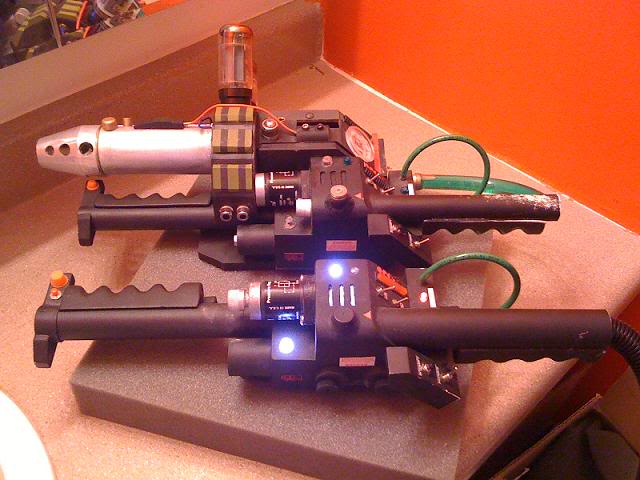
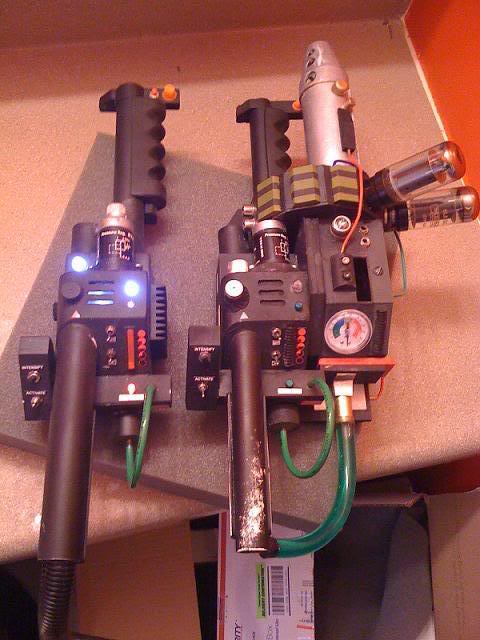
Now compare to the reference:
Look how fat the handle on the left wand (which is using 1" ID PVC) looks compared to this reference pic:
Look how much space there appears to be between the rear instrument box and the bottom of the handle:
As for your thrower body, there is no way you used 1" ID PVC and had 1/2" of space between the bottom of the handle and the instrument box.
The distance between the top of the thrower box and the instrument panel is approximately 1 9/16". The OD of 1" PVC is 1 5/6". That leaves 4/16", or 1/4". But this does not take into consideration the thickness of the walls of your thrower box. My thrower box has walls which were 1/8" thick. Unless your thrower is made of aluminum you are unlikely to have walls thinner than that. But let’s say you do. Subtract 1/16" from the above, and you’re left with a 3/16", at most.
In other words, unless you didn’t mount your rear instrument panel flush with the bottom of the front panel on the thrower, or you had some other measurement off, the gap couldn’t be anywhere near as large as you’re estimating.
Anyway, I will concede the Stephan’s plans do in fact show handles with a diameter of 1 1/4". But Stephan’s plans are by no means the final word on this matter, and if you just look at the reference photos above the handles are clearly much narrower than on the ThrowingChicken build, which is virutally identical to my own.
Also, please note that the build on the right does not have any welds on it, which is why it might look funny if you’re only looking where the handle joins the body.
On what do you base this assumption?
PVC’s OD is only 1/16" larger than the one which you specify. That is not nearly enough to throw off the appearance of the thrower handle as much as I’m seeing here. The handles on the planet hollywood thrower look much narrower than the PVC ones.
Also, let it be put on the record that you are the one whose advice I took!
Oh, and in regards to the above reference photos, please also note how large the 3/4" tubing looks compared to the handle on the real gun and on the throwing chicken model. There is quite a difference there too.
I said it was somewhere around 1/4-1/2" because I couldn’t go a measure it. The space is closer to 1/4". I have a throwingchicken v.2 gun body and I used 1" PVC pipe. The other thing that skews the look of the rear handle for most people is the fact that everyone puts the grip flush with the rear instrument bar (while it should be about 1/2" back from it). This creates the look of the rear handle being short and “chubby”.
This picture is a perfect example of what I just said. If the rear handle was the right length on the normal thrower in the above picture and the grip was moved back, it would look a lot closer to this reference shot you posted. The handles on the game thrower he made looks, to me, to be too skinny.
In the end though, I agree with what namebrand said about this subject. The 1" PVC is too large, but only by about .07" in diameter, compared to the aluminum piping used in the film’s props.
Based on my own research in building my own set of gun plans. I have based them largely off of Stefan’s plans, but have re-visited every detail using high res photos and such. The topic of the handles has come up before where people have said they should be 1.125" diameter because they are smaller than the body of a Clippard in the PH photos. If you compare the rear handle in the photos (since its pretty much on the same plane as the Clippard) it comes out to only a tiny bit smaller. A real valve is 1.31" and the handle is 1.25", and that is essentially the difference seen in screen caps and in the photos of the hero guns.
The main problem with most guns and spacing for the slo-blo box and such is that most people mount the handles too far from the edge of the gun body. It should only be about 0.0625" from both the top and side (the thickness of the aluminum used for the body of the gun essentially bent around the handle tube). Also handle length will largely affect the appearance, since if they are too short it will look too fat.
I’ve used 1.25" tube on my aluminum guns and they match visually to the hero guns in virtually every way, gap between the handle and the slo-blo box, width of the face on the bar graph side, comparison to the Clippard, etc.
The thrower body was made from 5/8" thick aluminum eh? Boy they don’t make em like they used to. 
Oops, one decimal place out, and apparently there is no more post editing? Anyway, in both cases I meant to put 0.0625". A 1.25" tube with a 0.625" wall would be a solid piece of round aluminum…lol
My thrower body was made from 1/8" thick material, and I mounted it right flush up against that. I’m gonna assume you meant to say that the thrower was made from 1/16" thick aluminum, and that is the distance which the handle should be mounted from the top and side edges.. which would match what stephan’s plans indicate.
But even so, that’s only a 1/16" difference. That alone wouldn’t have given me much more of a gap there. However, if I did have a small gap, say 1/8", and you take that 1/16" into acocunt, and the 1/16" difference between the PVC and the aluminum tube, that’d give you 1/4" in total for the gap.
Still, those handles in those reference photos look so much narrower…
…and that gap looks a lot bigger than a quarter of an inch.
Well now I’m uncertain of myself again.
I mean there is a gap of 1/4" if you look at Stephan’s plans. That is the result of the slightly narrower aluminum tube and the thinner walls on an aluminum thrower. Is that enough of a gap to match the movie thrower? Hard to say.
But when I look at my thrower and that throwingchicken one above… the handles look fat to me. And big relative to the 3/4 hose. And I mounted my grip in the right location, so it ain’t that.
Oh well. Either way is fine with me. Either I’m right about the measurements being off, or I built my thrower right after all.
I may be willing to accept that they are 1 1/8", but John’s revisiting of the plans and reference, Stefan’s plans, Sean’s plans, and the word of people who have actually held the original guns have told me that it is closer to 1 1/4". I chose to build my kit with 1" PVC in mind because it is pretty damn close to 1.25" and not too difficult to track down.
That all depends on how you mount the rear handle. The handle is supposed to run nearly flush to the top left side of the gun body, where the curve is. On my gun body I have tried to make that curve as thin as possible, but I can only go so far with it without weakening the structural integrity of the resin in that area. What I end up with is a 1.25" rear handle that is nearly 1/4" above the rear instrument bar, which is pretty much identical to Stefan’s plans. If someone somehow mounted a 1" PVC pipe onto my gun body and it resulted with it resting on my RIB then I have no idea how they did it.
Well keep in mind that the pipe still has to curve down. I have no doubt that the gap might be slightly bigger than 1/4", it might be 3/8" if I am being generous, but I think that space can be accounted for when you consider the limitations of the resin and having to use 1"PVC vs dead on 1.25" pipe.
The gap looks a lot larger because the shadow is being cast from nearly halfway up the diameter of the handle. There are unfortunately no public photos that show the gap better but it is basically 1/4".
I meant that the gun body is made from 0.0625" thick aluminum, possibly 0.060" or something close to that, bent into shape and then welded. As I mentioned and TC just mentioned, the handle is nearly flush with the side and top of the gun body, only 0.0625" or so.
These are the dimensions that match up visually and during scaling to the hero gun. Right click to see larger more legible version.